


Email(FOR EMPLOYERS)
marketing@talent-spot.com.cn


Consult
What are you looking for?
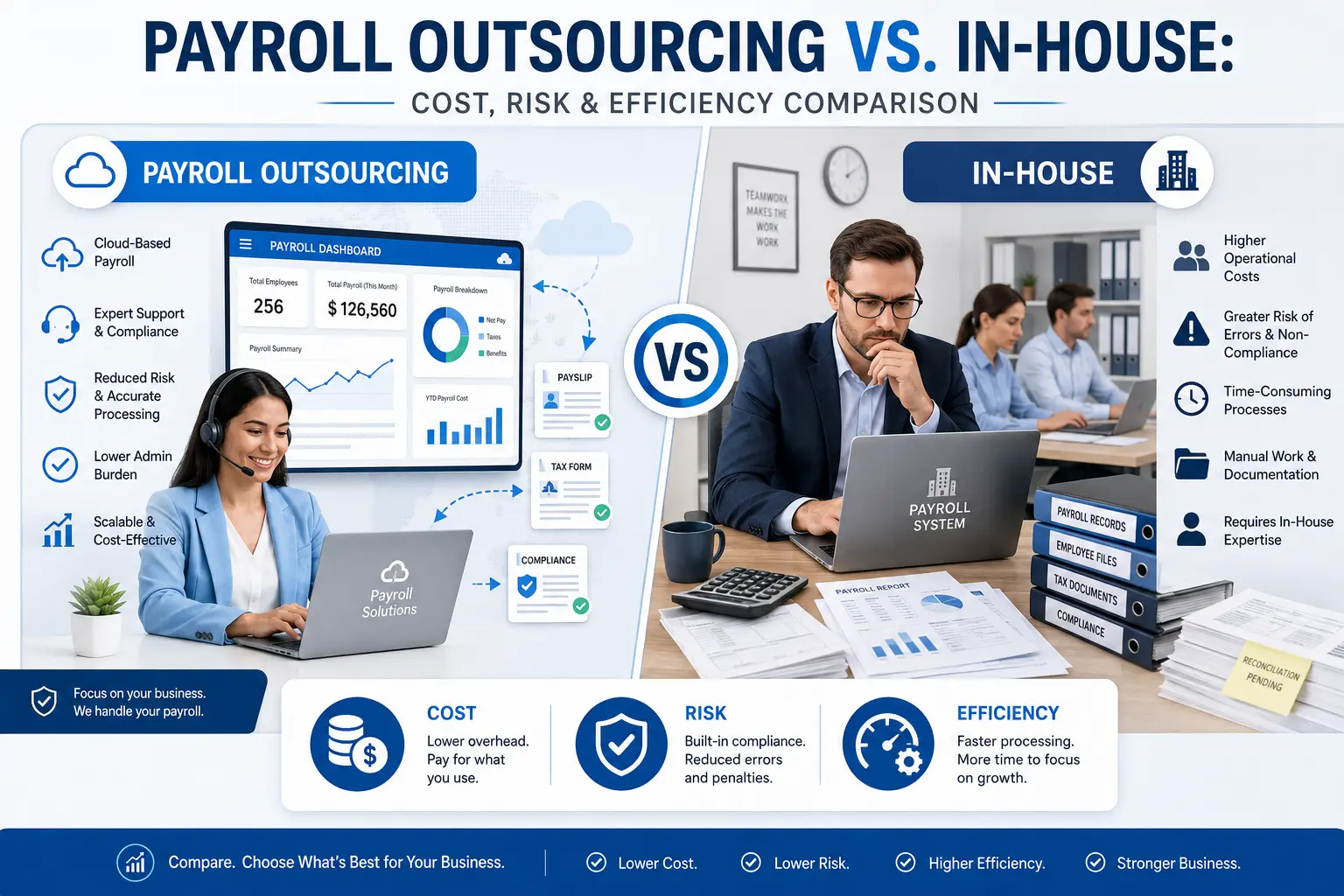
Payroll is one of the most critical business functions. Employees expect accurate and timely compensation, governments require proper tax reporting, and labor regulations continue to become more complex across jurisdictions. As organizations grow, many HR and finance leaders face an important decision: should payroll be managed internally or outsourced to a specialist provider?
There is no universal answer. The best approach depends on company size, geographic footprint, compliance requirements, available resources, and long-term growth plans. For organizations operating across multiple countries or experiencing rapid expansion, payroll outsourcing services often provide greater efficiency and compliance support. For businesses with stable local operations and dedicated payroll teams, an in-house model may offer more direct control.
This guide compares payroll outsourcing and in-house payroll management from a practical business perspective, focusing on cost, compliance risk, operational efficiency, scalability, and long-term value.
| Factor | Payroll Outsourcing | In-House Payroll |
|---|---|---|
| Initial Setup Cost | Low | Higher |
| Payroll Expertise | Provider Supplies Experts | Internal Team Required |
| Compliance Management | Specialized Support | Company Responsibility |
| Scalability | High | Moderate |
| Technology Investment | Included | Company Funded |
| Global Payroll Capability | Strong | Complex |
| Direct Control | Lower | Higher |
| Administrative Workload | Lower | Higher |
Payroll outsourcing involves hiring a specialized third-party provider to manage payroll-related activities on behalf of your organization.
Modern payroll outsourcing services commonly include:
Payroll calculation and processing
Salary payments
Tax withholding and filing
Social security contributions
Employee payslip generation
Leave and attendance integration
Year-end tax reporting
Payroll compliance monitoring
Multi-country payroll management
The outsourcing provider assumes responsibility for payroll administration while the company maintains oversight and approval authority.
In-house payroll refers to payroll functions managed directly by a company's internal HR, finance, or payroll department.
The organization is responsible for:
Payroll software selection
Payroll calculations
Tax filings
Regulatory compliance
Employee payment processing
Record keeping
Government reporting
System maintenance
While this model offers maximum control, it also requires greater internal resources and expertise.
Many companies underestimate the true cost of internal payroll management.
Common expenses include:
Payroll staff salaries
Payroll software licenses
Training programs
Compliance updates
IT support
Data security systems
Audit preparation
Error correction costs
For multinational organizations, these expenses can increase significantly as regulatory complexity grows.
Outsourcing providers typically charge:
Per employee per month fees
Payroll cycle processing fees
Setup fees
Additional compliance services
International payroll management fees
While outsourcing involves ongoing service costs, businesses often reduce internal staffing and technology expenditures.
| Business Type | Usually More Cost Effective |
|---|---|
| Small Startup | Outsourcing |
| Growing SME | Outsourcing |
| Multi-Country Organization | Outsourcing |
| Large Enterprise with Dedicated Payroll Team | Depends on Scale |
| Single-Country Business with Stable Workforce | Often In-House |
Compliance is one of the most significant considerations when evaluating payroll strategies.
Tax filing errors
Late reporting penalties
Incorrect overtime calculations
Misclassification of workers
Missed regulatory updates
Labor law violations
As regulations evolve, internal teams must continuously monitor legal changes.
Experienced payroll providers invest heavily in compliance expertise.
Benefits often include:
Dedicated compliance specialists
Regulatory monitoring
Automated updates
Audit support
Country-specific expertise
Reduced risk of reporting errors
For organizations operating internationally, outsourcing frequently provides stronger compliance protection.
Internal payroll teams often spend substantial time on repetitive administrative tasks.
These may include:
Data collection
Attendance verification
Payroll calculations
Tax reporting
Employee inquiries
Record management
Manual processes increase the likelihood of errors and consume valuable HR resources.
Professional providers use specialized payroll platforms and standardized workflows.
Advantages include:
Automation
Faster payroll cycles
Reduced administrative workload
Centralized reporting
Improved accuracy
Self-service employee portals
Organizations can redirect internal resources toward strategic HR and business initiatives.
Managing payroll internally often requires investment in:
Payroll software
HRIS integration
Attendance systems
Data storage infrastructure
Cybersecurity solutions
Backup systems
Technology upgrades and maintenance can create ongoing costs.
Most payroll providers offer:
Cloud-based platforms
Employee self-service access
Automated compliance updates
Multi-country payroll support
Real-time reporting dashboards
Enhanced security protocols
Businesses gain access to enterprise-grade technology without major capital investment.
International payroll introduces additional complexity.
Companies hiring across multiple countries must navigate:
Different tax systems
Currency fluctuations
Local labor laws
Social insurance requirements
Country-specific reporting obligations
Benefit administration rules
Many organizations find that managing these requirements internally becomes increasingly difficult as global headcount grows.
Payroll outsourcing is often ideal when:
The company is expanding internationally.
Internal payroll expertise is limited.
Compliance risk is a major concern.
HR resources are stretched.
The organization is growing rapidly.
Multi-country payroll management is required.
A technology company hires employees in Singapore, Australia, Japan, and Germany. Managing payroll internally across four regulatory systems would require substantial expertise and infrastructure. Outsourcing provides immediate access to local compliance knowledge and payroll administration capabilities.
Internal payroll management may be appropriate when:
The workforce is concentrated in one country.
The company has experienced payroll professionals.
Complex internal compensation structures exist.
Management requires maximum process control.
Long-term payroll costs justify dedicated resources.
A manufacturing company with 2,000 employees operating exclusively in one jurisdiction may achieve cost efficiencies through an established internal payroll department.
The more countries, employment types, and payroll rules involved, the greater the value outsourcing may provide.
Payroll errors can be costly. Organizations lacking specialized payroll knowledge should carefully evaluate outsourcing options.
Rapidly growing businesses often benefit from outsourcing because providers can support workforce expansion without significant internal hiring.
Companies operating in heavily regulated environments may prioritize the compliance support offered by payroll specialists.
The payroll industry continues to evolve through technology and workforce transformation.
Key trends include:
AI-assisted payroll processing
Global workforce expansion
Cloud-based payroll platforms
Real-time payroll reporting
Integrated HR and payroll systems
Growing demand for payroll outsourcing services
As compliance requirements become more complex, organizations increasingly seek specialized partners to manage payroll efficiently and accurately.
Both payroll outsourcing and in-house payroll management can be effective when aligned with business needs. However, for many modern organizations—especially those operating internationally or scaling rapidly—payroll outsourcing services offer significant advantages in compliance management, efficiency, scalability, and risk reduction.
Companies with established payroll infrastructure and stable local operations may continue to benefit from in-house management. The most successful organizations evaluate not only direct costs but also compliance exposure, technology requirements, administrative workload, and future growth plans before making a decision.
Reputable providers use advanced encryption, cybersecurity measures, and compliance frameworks to protect sensitive payroll data.
Yes. Many providers specialize in multi-country payroll administration and compliance management.
While providers assume many administrative responsibilities, companies should still maintain governance and oversight.
Savings vary based on workforce size, geographic footprint, and internal payroll costs. Many organizations achieve both cost reductions and efficiency gains.
Yes. Many companies transition to outsourcing as they expand, enter new markets, or seek greater operational efficiency.