

Email(FOR EMPLOYERS)
marketing@talent-spot.com.cn


Consult
What are you looking for?
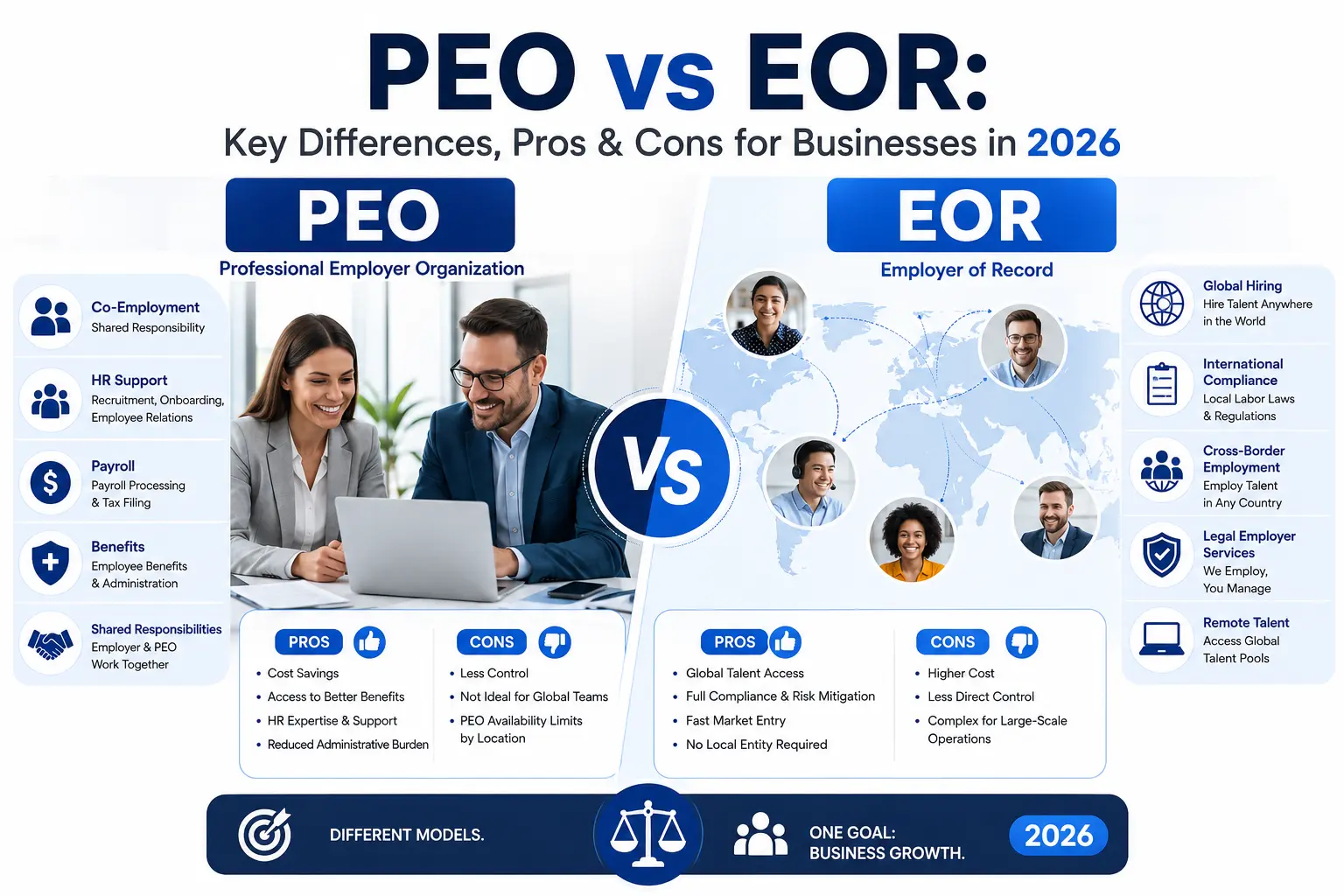
As companies expand internationally and embrace remote work, choosing the right employment solution has become a critical business decision. Two of the most commonly discussed options are PEO and EOR. While both help organizations manage HR, payroll, compliance, and employee administration, they serve fundamentally different purposes.
For businesses planning domestic growth, a Professional Employer Organization (PEO) may provide valuable HR support. For companies hiring employees in countries where they do not have a legal entity, an Employer of Record (EOR) is often the faster and more compliant solution.
Understanding the differences between PEO and EOR can help businesses avoid compliance risks, reduce administrative burdens, and select the most cost-effective workforce strategy.
The biggest distinction between a PEO and an EOR is legal employment responsibility.
| Category | PEO | EOR |
|---|---|---|
| Employment Model | Co-employment | Legal employer |
| Requires Local Entity | Yes | No |
| Payroll Management | Shared Responsibility | Handled by EOR |
| Compliance Support | Advisory & Administrative | Full Compliance Management |
| International Hiring | Limited | Excellent |
| Best For | Domestic Growth | Global Expansion |
In a PEO arrangement, your company remains the legal employer and must maintain a registered legal entity in the country where employees are hired.
With an EOR, the provider becomes the legal employer on paper while employees work exclusively for your company.
A Professional Employer Organization (PEO) operates under a co-employment model.
The PEO shares certain employer responsibilities with your company, including:
Payroll administration
Benefits management
Tax filings
HR support
Risk management
Workers' compensation administration
Employment documentation
Your business remains the legal employer and retains responsibility for employment decisions, workplace policies, and regulatory obligations.
Access to better employee benefits
Reduced HR workload
Payroll efficiency improvements
Lower administrative costs
Support for growing businesses
Assistance with labor compliance
Requires local legal entity
Limited support for international hiring
Shared compliance responsibilities
Less suitable for rapid global expansion
An Employer of Record legally hires employees on behalf of another company.
The EOR assumes responsibility for:
Employment contracts
Payroll processing
Tax withholding
Benefits administration
Employment compliance
Statutory contributions
Local labor law adherence
Your company continues to direct the employee's work activities, projects, and performance.
No need to establish foreign entities
Faster hiring timelines
Reduced compliance risk
Simplified global expansion
Scalable international workforce management
Access to talent worldwide
Higher per-employee service fees in some markets
Less direct control over employment administration
May become less cost-effective for very large teams
Many business leaders misunderstand co-employment.
Under a PEO arrangement:
Your company remains the primary employer.
The PEO manages HR administration.
You control hiring and firing decisions.
You maintain legal presence within the country.
The PEO assists with compliance but does not fully assume legal employer responsibilities.
This model works well for established companies operating within their home market.
Under an EOR arrangement:
The EOR becomes the legal employer.
The employee works exclusively for your organization.
The EOR manages payroll and statutory obligations.
The EOR ensures local compliance.
Your company directs all operational work.
This allows companies to hire employees internationally without opening a subsidiary.
| Cost Factor | PEO | EOR |
|---|---|---|
| Entity Setup Required | Yes | No |
| Entity Maintenance | Required | Not Required |
| HR Administration | Reduced | Fully Outsourced |
| International Compliance | Limited | Included |
| Expansion Speed | Moderate | Fast |
Although EOR fees may appear higher initially, many organizations discover that avoiding entity setup costs and compliance expenses makes EOR solutions more economical for international hiring.
A PEO is typically the better choice when:
You already have a legal entity.
You hire only within your existing market.
You need HR and payroll support.
You want better employee benefits.
You have an established workforce.
You plan long-term domestic growth.
A U.S.-based company with 150 employees wants to improve benefits administration and reduce HR workload while continuing operations solely within the United States.
A PEO is often an excellent solution.
An EOR is generally the better option when:
You want to hire internationally.
You do not have a local entity.
You need rapid expansion.
You want to reduce compliance exposure.
You plan to test new markets.
You hire remote employees globally.
A software company headquartered in Singapore wants to hire engineers in Germany, sales representatives in Australia, and support specialists in Brazil.
Rather than establishing entities in three countries, an EOR allows immediate hiring through compliant local employment structures.
Yes.
Many multinational organizations use both models simultaneously.
For example:
Use a PEO in countries where the company already has legal entities.
Use an EOR in new expansion markets.
Transition from EOR to PEO after establishing local entities.
This hybrid strategy often delivers the best balance between flexibility and cost efficiency.
Selecting the wrong workforce solution can create significant challenges.
Worker misclassification penalties
Payroll tax errors
Employment contract violations
Benefits non-compliance
Permanent establishment tax exposure
Labor law disputes
Government audits
Businesses expanding internationally should carefully evaluate compliance obligations before making a decision.
If not, an EOR may be the only practical option.
EOR solutions generally support much faster onboarding.
Small teams often benefit from EOR arrangements, while larger long-term operations may eventually justify entity establishment and PEO support.
EOR providers typically assume a greater share of compliance responsibility.
Several trends are influencing workforce management strategies in 2026:
Remote-first hiring models
Cross-border talent acquisition
AI-powered HR technology
Global skills shortages
Increasing labor law complexity
Demand for flexible workforce structures
As organizations expand beyond traditional geographic boundaries, EOR adoption is expected to continue growing rapidly.
When comparing PEO and EOR, neither solution is universally better. The right choice depends on your company's expansion goals, legal structure, workforce size, and hiring strategy.
A PEO is often the preferred option for businesses with existing entities seeking HR efficiency and improved employee administration. An EOR is typically the superior choice for international hiring, market entry, and rapid global expansion without establishing local subsidiaries.
By understanding the strengths, limitations, and costs of each model, businesses can build compliant, scalable workforce strategies that support sustainable growth in 2026 and beyond.
Per employee, EOR services may cost more, but they can eliminate substantial entity setup and maintenance expenses.
Generally, a PEO requires the client company to have a local legal entity in the target country.
Yes. EOR solutions are commonly used for managing global remote teams.
Yes. Many organizations start with an EOR and transition to a PEO after establishing local entities.
For international hiring and market testing, EOR services are often the fastest and most flexible option for startups.