

Email(FOR EMPLOYERS)
marketing@talent-spot.com.cn


Consult
What are you looking for?
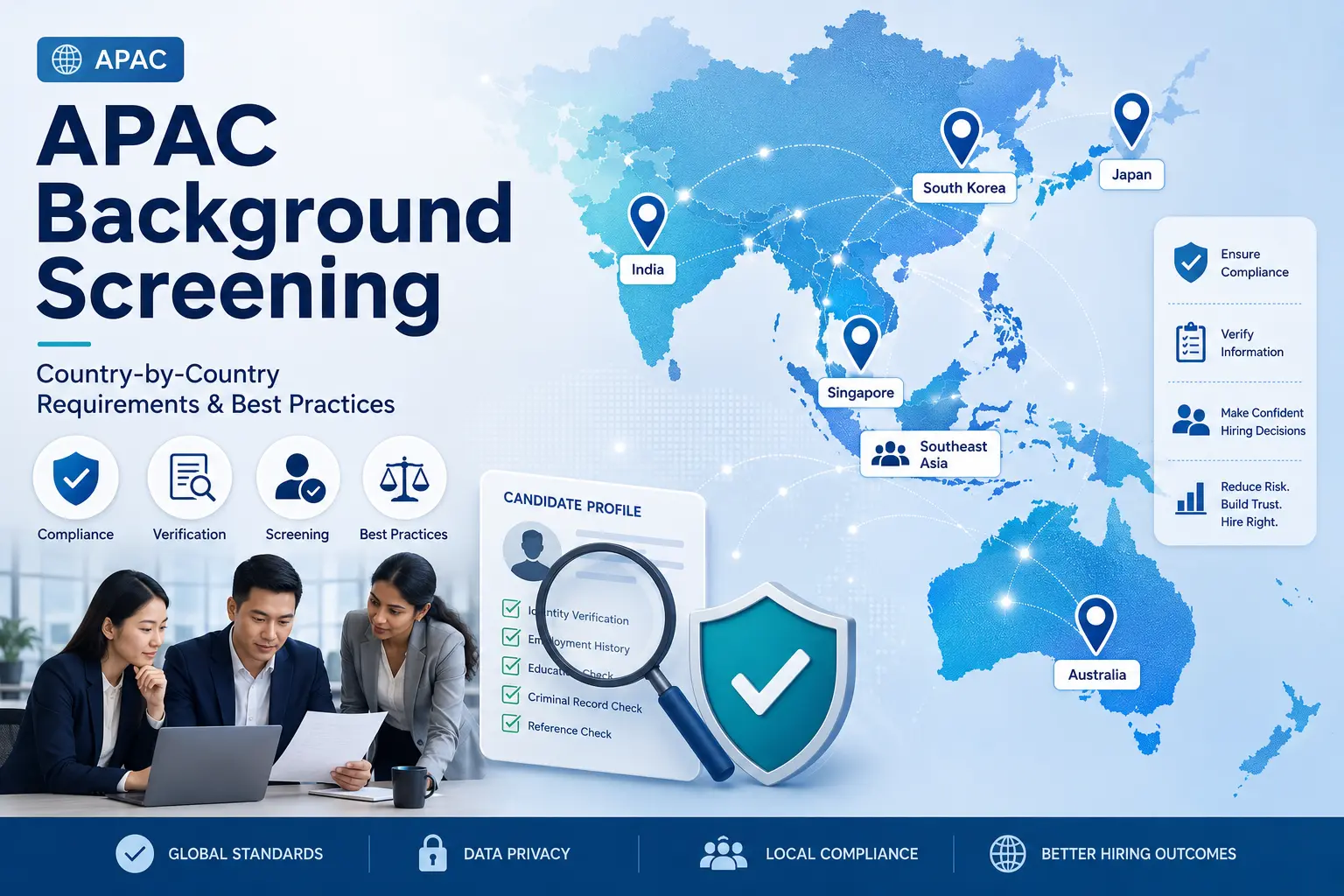
Hiring across the Asia-Pacific region presents tremendous opportunities for businesses seeking skilled talent, multilingual capabilities, and access to fast-growing markets. However, background screening requirements vary significantly between countries. What is legally acceptable in Singapore may be restricted in Japan, while employment verification practices common in Australia may require additional employee consent in South Korea.
For multinational employers, understanding country-specific compliance obligations is essential. Effective employee background check services can help organizations mitigate hiring risks, prevent fraud, maintain workplace safety, and ensure compliance with local privacy and labor regulations.
This guide provides a practical overview of background screening requirements across major APAC countries and outlines best practices for building compliant hiring programs in 2026.
As remote hiring, cross-border recruitment, and international workforce mobility continue to increase, organizations face growing challenges in verifying candidate credentials.
Common hiring risks include:
Resume fraud
Fake educational qualifications
Employment history manipulation
Identity fraud
Undisclosed criminal records where legally permissible
Financial misconduct in sensitive positions
Regulatory non-compliance
Professional employee background check services help organizations verify candidate information while complying with local data privacy laws.
Although screening regulations differ between countries, several common principles apply across most APAC jurisdictions.
Most APAC countries require employers to obtain explicit consent before conducting background checks.
Countries throughout APAC have strengthened privacy regulations, limiting how employers collect, process, store, and transfer candidate information.
Information collected should generally be relevant to the position being filled.
Many jurisdictions regulate international transfers of personal data.
Personal Data Protection Act (PDPA)
Employment Act
Identity verification
Employment verification
Education verification
Professional license verification
Reference checks
Employers must obtain candidate consent before collecting personal information. Criminal record checks are generally limited to circumstances where they are relevant to the position.
Privacy Act 1988
Australian Privacy Principles
State-specific employment regulations
National criminal history checks
Employment verification
Education verification
Professional registration verification
Right-to-work checks
Criminal history information should only be considered where relevant to the role. Employers must ensure fair and non-discriminatory hiring decisions.
Act on the Protection of Personal Information (APPI)
Identity verification
Employment verification
Academic verification
Reference checks
Japan has strong privacy protections. Criminal record screening is highly restricted and often difficult to obtain through standard hiring processes.
Employers should focus on employment and education verification rather than extensive investigative screening.
Personal Information Protection Act (PIPA)
Identity verification
Academic verification
Employment verification
Professional credential verification
South Korea maintains some of the strictest privacy regulations in Asia. Candidate consent and proper data handling procedures are essential.
Personal Data (Privacy) Ordinance (PDPO)
Employment history verification
Education verification
Reference checks
Identity verification
Personal data collection must be necessary, proportionate, and transparent.
Personal Information Protection Law (PIPL)
Cybersecurity Law
Data Security Law
Identity verification
Education verification
Employment verification
Professional qualification verification
China has introduced comprehensive data privacy and cross-border data transfer regulations. Employers must pay close attention to consent requirements and data processing obligations.
Digital Personal Data Protection Act (DPDP)
Sector-specific requirements
Identity verification
Address verification
Employment verification
Education verification
Criminal record screening where applicable
Background screening is widely used, particularly within IT, financial services, healthcare, and outsourcing industries.
Personal Data Protection Act (PDPA)
Identity verification
Employment verification
Education verification
Reference checks
Employers should obtain explicit consent before initiating screening activities.
Data Privacy Act of 2012
Identity verification
Employment verification
Academic verification
Reference checks
Candidate authorization should be documented before collecting personal information.
| Screening Type | Purpose |
|---|---|
| Identity Verification | Confirm candidate identity |
| Employment Verification | Validate previous employment |
| Education Verification | Confirm academic credentials |
| Reference Checks | Assess work performance |
| Professional License Verification | Validate certifications |
| Criminal Record Screening | Assess legal history where permitted |
| Right-to-Work Verification | Confirm employment eligibility |
| Global Watchlist Screening | Identify sanctions risks |
Every country applies different standards for collecting and processing personal data.
Employment records, educational credentials, and government documents may require translation and local verification expertise.
Verification timelines differ significantly among jurisdictions.
Remote hiring has increased the need for international screening programs that remain compliant across multiple countries.
Always secure candidate authorization before initiating screening.
Avoid collecting information unrelated to the position.
Professional employee background check services understand local regulations and can help ensure compliance.
Develop standardized screening procedures while allowing country-specific adjustments where necessary.
Implement strong data security controls and comply with applicable privacy regulations.
Professional screening solutions are particularly valuable when:
Hiring across multiple APAC countries
Recruiting remote employees
Managing high-volume recruitment
Filling regulated positions
Hiring executives and senior leaders
Expanding internationally
Third-party providers often offer faster turnaround times, stronger compliance frameworks, and broader verification capabilities than internal HR teams.
Several trends are shaping screening programs in 2026:
Stronger privacy regulations
AI-assisted verification technologies
Digital identity verification
Remote hiring growth
Increased cross-border recruitment
Enhanced fraud detection capabilities
Organizations should expect compliance requirements to become increasingly important as governments continue strengthening personal data protection laws.
APAC remains one of the most dynamic hiring regions in the world, but successful recruitment requires a thorough understanding of country-specific screening requirements. From Singapore and Australia to Japan, China, and India, employers must balance risk mitigation with privacy compliance.
By implementing standardized screening policies, obtaining proper consent, and utilizing reliable employee background check services, organizations can improve hiring quality, reduce compliance risks, and build trustworthy workforces across the Asia-Pacific region.
Rules vary significantly by country. Some jurisdictions permit criminal checks under certain conditions, while others impose substantial restrictions.
Yes. Most APAC countries require informed consent before conducting background checks.
Simple verifications may take a few days, while multi-country screening programs can require several weeks.
Some countries impose restrictions on cross-border data transfers, requiring additional compliance measures.
Professional providers offer local expertise, regulatory compliance support, verification efficiency, and scalable screening capabilities for multinational hiring programs.